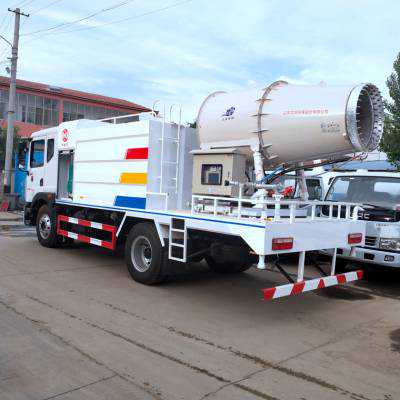
There is nothing more frustrating for a site manager than watching a heavy-duty dust control truck dribble water instead of blasting it. You have a 12,000-liter tank, a diesel engine, and a PTO engaged, yet the spray width is pathetic.
When the water pump pressure of the sprinkler is insufficient, it is rarely a mystery; it is physics. As a manufacturer specializing in custom hydraulic systems for municipal and mining vehicles, we analyze these failures through engineering blueprints, not just guesswork. Here is the technical breakdown of why your system is losing head pressure and how to fix it.
The #1 Suspect: Suction Line Vacuum Leaks
Before you tear apart the pump, look at your plumbing. Most industrial sprinkler trucks use self-priming centrifugal pumps. These rely entirely on creating a vacuum in the inlet pipe to lift water.
If there is even a microscopic air leak in the suction line, the pump will suck air instead of water. Air is compressible; water is not. According to pump diagnostic guides, air leaks in the suction line are the most common cause of failure to prime or low discharge pressure.
• The Symptom: You might hear an unusual "whirring" noise, or the pressure gauge will flutter near zero.
• The Fix: Check the suction hose for cracks and ensure the inlet pipe system is sealed reliably. A loose clamp or a dried-out O-ring on the suction side destroys the vacuum degree, making high-pressure output impossible.
Internal Hydraulics: Impeller Clearance and Wear
If your suction line is airtight but pressure is still low, the problem is likely inside the pump casing. Centrifugal pumps generate pressure by accelerating water outward via the impeller. This requires a tight tolerance between the impeller vanes and the pump casing.
Over time, especially if you are drafting water from sediment-heavy ponds, the sand acts like sandpaper.
• The Failure Mode: The gap between the impeller and the pump casing increases due to wear. Instead of being forced out the discharge, water bleeds back internally from the high-pressure side to the low-pressure side.
• The Signs: If the impeller is worn or deformed, the pump consumes engine power but generates no head pressure. In this scenario, no amount of RPM increase will fix it; you must replace the impeller or the casing cover.
The Power Transmission Factor (PTO & RPM)
Your pump is only as good as the power driving it. In sprinkler trucks, the engine power is transferred via the Power Take-Off (PTO) and a drive shaft.
Technical manuals for heavy-duty chassis like Dongfeng indicate that the optimal working speed for sprinkler operations is typically around 1500 r/min. If your engine is running at idle, you will not build pressure.
• Low Speed: If the pump speed is too low, the centrifugal force is insufficient to create the required pressure head.
• PTO Slippage: Check the connection between the power take-off device and the water pump. If the PTO internal gears are worn or the drive shaft is slipping, the pump shaft won't spin at the required velocity to move the water volume, resulting in weak spray.
Flow Restriction: Valve Logic and Filtration
Sometimes the pump is working perfectly, but the water has nowhere to go. Modern sprinkler trucks use complex ball valve systems (often 4-way, 3-position valves) to switch between flushing, spraying, and self-cleaning.
• Valve Positioning: If the inlet or outlet valve is not fully opened, you introduce massive friction loss. A common operator error is leaving ball valves in a "semi-open" state for long periods. This not only restricts flow but causes turbulence that damages the sealing ring, leading to internal bypassing.
• Filtration: A blocked filter screen is a silent pressure killer. If the mesh is clogged with algae or debris, the pump is starved of water. This can lead to cavitation, where vacuum bubbles implode inside the pump, causing noise and pitting the metal impeller.
Diagnosing hydraulic failure requires a systematic approach. Start by verifying your vacuum integrity, then check your RPMs, and finally inspect the internal tolerances of the pump. Understanding these engineering principles ensures you aren't just swapping parts, but solving the root cause when the water pump pressure of the sprinkler is insufficient.