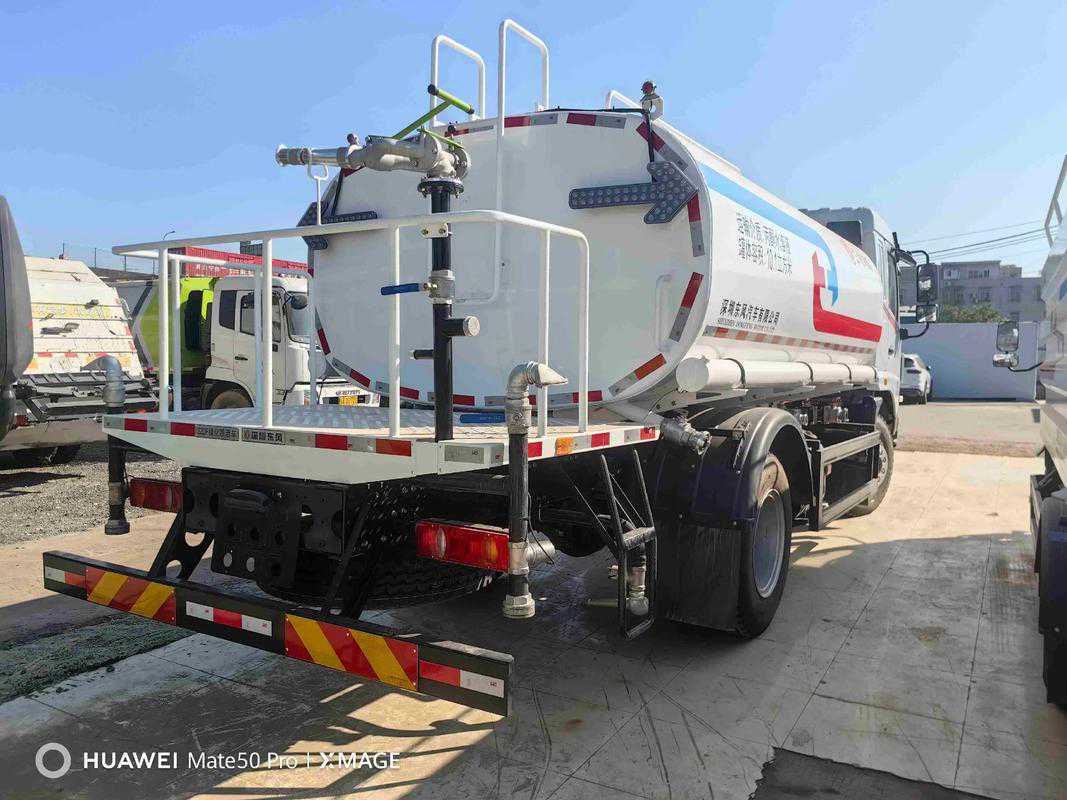
“How many gallons does it hold?”
I hear this question every day. But as a fleet manager, I know it’s the wrong question. The right question is: “How much water can I carry without cracking my chassis or getting a DOT fine?”
Water is heavy. Deceptively heavy. At roughly 8.34 pounds per gallon, a 2,000-gallon tank is carrying over 16,000 pounds of payload—and that doesn’t include the weight of the steel tank itself, the pump, and the plumbing. I’ve seen too many operators try to mount a 4,000-gallon tank on a single-axle chassis because “it fits.” That’s not just illegal; it’s dangerous.
Understanding Capacity vs. Capability
You need to match the tank to the GVWR (Gross Vehicle Weight Rating).
If you overload a truck, the first thing to go isn’t the engine—it’s the suspension and the frame rails. I have seen frame rails crack right behind the cab because the tank was too heavy and the liquid surge acted like a hammer every time the truck stopped.
The Rule of Thumb: A standard single-axle truck usually tops out safely at 2,000 gallons. If you need 4,000 gallons, you need a tandem axle. If you try to cheat this, the DOT scales will catch you, or your leaf springs will snap.
Operational Efficiency: The “Pedestrian Dance”
Efficiency isn’t just about hauling more water; it’s about using it smarter. One of the biggest operational inefficiencies I see is the “stop-and-wait.”
This happens when an operator approaches a pedestrian or parked car. They stop the truck, wait for the person to move, and then start again. This kills your fuel economy and brake life.
Instead, train your drivers on the “One-Side Cut.” Modern trucks allow you to cut the curb-side spray independently while keeping the street-side spray active.
Technique: As you approach the obstacle, drop RPMs to 1,100, cut the right-side switch, pass the obstacle, and flip it back on. No stopping required. This keeps the momentum of that 40,000lb vehicle moving, saving massive amounts of diesel.
The True Cost of Overloading (TCO Analysis)
Let’s look at the Total Cost of Ownership.
If you overload your truck by 10% to save a trip:
1. Tires: Your tire sidewalls will overheat and fail prematurely.
2. Brakes: Your stopping distance increases, and brake pad wear accelerates by 30%.
3. Fuel: You might think one heavy trip is cheaper than two light trips, but when you factor in the engine strain and the risk of a $5,000 suspension repair, the math doesn’t work.
Run your trucks at 90% capacity. It extends the vehicle life by years.